Welcome to the new edition of This Week in Science!
Your nose is even more important than you think. A study published in Nature reveals that the nose and upper airway are vital training grounds for immune cells, enhancing their ability to combat future infections. Researchers discovered that these regions contain long-lived immune cells that 'memorize' pathogens, which could improve mucosal vaccines administered via the nose or throat, potentially surpassing traditional muscle-injected vaccines in effectiveness.
This study, conducted by Sydney Ramirez and colleagues at the La Jolla Institute for Immunology, involved monthly nasopharyngeal swabs of 30 healthy adults over a year. They identified millions of immune cells, including those with immune memory. Notably, the researchers could also swab adenoids, revealing active germinal centers that train B cells to produce antibodies, even in adults whose adenoids typically shrink over time.
The research gained new relevance during the COVID-19 pandemic, as variants like Omicron spread efficiently in the upper airway. Findings showed active germinal centers in participants regardless of illness, suggesting continuous immune activity. This could aid in understanding immune responses and testing intranasal vaccines. However, the presence of pre-existing antibodies in the upper airways might challenge the efficacy of such vaccines, according to immunologist Donna Farber.
Source: Nature
Our brains in sync to help us understand each other. Researchers have discovered that brain-to-brain coupling during conversation is significantly influenced by the words used and their context, according to a study published in Neuron. This synchronization occurs as the speaker's brain processes linguistic content before speaking, and the listener's brain mirrors this activity after hearing the words. The study, led by Zaid Zada and Samuel Nastase of Princeton University, utilized intracranial electrocorticography on epilepsy patients during natural conversations to collect high-resolution brain activity data.
The team employed the GPT-2 language model to analyze the contextual meaning of words in conversations. They found that context-specific brain activity peaks in the speaker's brain around 250 milliseconds before speaking, with corresponding spikes in the listener's brain approximately 250 milliseconds after hearing the words. This context-based approach outperformed previous models in predicting shared brain activity patterns between speakers and listeners.
The findings underscore the importance of context in verbal communication, as it significantly aligns brain activity between individuals. Future research aims to apply this model to other brain activity data types, such as fMRI, to further explore brain area coordination during conversations. The study highlights the potential for large language models to enhance our understanding of linguistic and neural interactions.
Source: Neuron
Blood vessels have been overlooked in brain health research. A Penn State-led study underscores the critical role of healthy blood vessels for brain health, particularly in addressing age-related cognitive decline and neurodegenerative diseases like Alzheimer’s. Published in Nature Communications, the research highlights the brain’s vascular network as a key player in the onset of such disorders. Aging, a primary factor in neurodegenerative diseases, significantly alters the brain’s vasculature, yet this aspect is often overlooked in favor of studying neuron structure and function.
The team, using high-resolution 3D mapping techniques like serial two-photon tomography and light sheet fluorescence microscopy, mapped the vascular network in young and old mouse brains. They discovered that vascular changes were more pronounced in deep brain areas such as the basal forebrain, deep cortical layers, and hippocampal network—regions vital for functions like memory and sleep. These changes included a 10% decrease in vascular length and branching density, twisted arteries, slower vascular response, and leaky blood vessels due to pericyte loss, which compromise the blood-brain barrier.
This research aims to pave the way for early diagnosis and potential treatments for neurodegenerative disorders by providing insights into how the brain’s vascular system deteriorates with age, impacting neuron function and overall brain health.
Source: Nature Communications
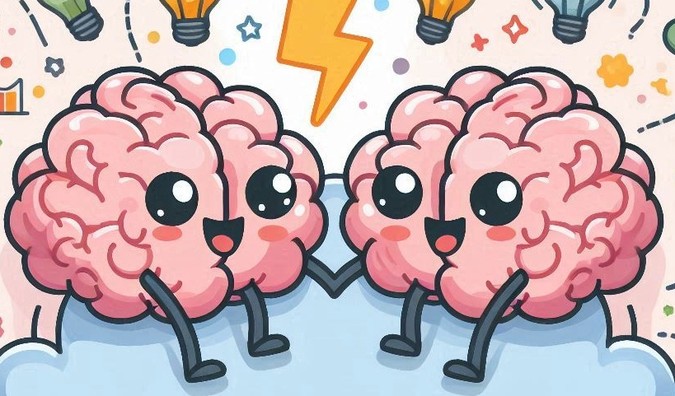
Cover image: Coordinated activity in two brains emerges in natural conversations. Image generated using DALL-E (copilot.microsoft.com)
Stats
- Recommendations n/a n/a positive of 0 vote(s)
- Views 4882
- Comments 0