It is that time of the week again: time for a new highlight of the past few days in science! Just get yourself a cup of coffee and scroll down for some brief but fascinating snapshots from medicine, biology and AI.
What do babies and ChatGPT have in common? A study conducted by researchers at Trinity College Dublin reveals that the seemingly helpless period of infancy serves a critical role in human development, akin to the pre-training phase of AI models like ChatGPT. The research challenges the long-held belief that infants are born with immature brains, suggesting instead that many brain systems are already active and processing sensory information from birth.
During this early stage, infants engage in a form of 'pre-training,' where their brains are exposed to a vast amount of sensory inputs, allowing them to build foundational models of the world around them. This process is analogous to how AI systems are pre-trained on extensive datasets before fine-tuning for specific tasks. This early learning enables infants to quickly and efficiently generalize knowledge, setting a robust foundation for more complex cognitive functions as they grow.
Understanding this process provides new insights into both human cognitive development and artificial intelligence. It suggests that the prolonged period of dependency in human infants is not a developmental delay but a strategic phase for learning and adaptation. This perspective could inform future AI research, highlighting the importance of extensive pre-training on diverse data to build adaptable and efficient models.
The implications of this study offer potential advancements in AI technology by mimicking the natural learning processes observed in human infants. Such insights underscore the value of integrating knowledge from cognitive science and artificial intelligence to enhance our understanding and development of intelligent systems.
Source: Cell
Running machine learning experiments on a brain organoid. So-called wetware computing is a new field combining biology and technology. It uses living brain cells (neurons) to perform tasks similar to how computer-based artificial neural networks (ANNs) work.
Recently researchers created the Neuroplatform, a system that allows large-scale experiments with brain cell clusters (organoids). This platform can grow new organoids quickly, monitor their activity continuously, and provide electrical stimulation. It also includes an automated system to maintain the right conditions for these organoids, minimizing disruptions.
Over the past three years, the Neuroplatform has been used to conduct experiments on over 1,000 brain organoids, collecting vast amounts of data. Researchers can access and control the platform remotely using a special interface that integrates with popular programming tools like Python and Jupyter Notebooks. This setup supports complex, around-the-clock experiments and can be used by scientists worldwide.
Why are wetware computing - and systems like Neuroplatform - a goal worth pursuing? The increased use and complexity of ANNs in tools like ChatGPT have significantly impacted energy consumption, with training large models like GPT-3 requiring around 10 GWh. This energy demand is starkly contrasted by the human brain's efficiency, which operates on 20 W of power despite having 86 billion neurons, leading researchers to explore biological neural networks (BNNs) as a potential alternative. The energy costs of generating billions of words daily for services like ChatGPT highlight the need for more energy-efficient computing solutions.
In 2024, the Neuroplatform system became freely available for research, and many groups are already using it.
Source: Frontiers in Artificial Intelligence
A quick MRI scan may predict Alzheimer’s. A new study suggests that a 10-minute brain scan could detect dementia up to nine years before symptoms appear, with an estimated 80% accuracy. Scientists from Queen Mary University of London used functional MRI (fMRI) scans of "resting" brain activity to identify early signs of dementia by analyzing changes in the brain's default mode network (DMN), which is vulnerable to Alzheimer's disease. The study involved 1,100 UK Biobank volunteers, with 81 eventually developing dementia. AI algorithms identified DMN changes characteristic of those at risk, allowing the model to predict dementia onset within a two-year margin of error.
The study, published in Nature Mental Health, highlights the potential of combining brain scans with blood tests targeting Alzheimer’s-related proteins for comprehensive early diagnosis. However, some experts, like Dr. Sebastian Walsh from the University of Cambridge, urge caution, noting the need for larger, long-term studies to confirm these findings. Dr. Richard Oakley from the Alzheimer’s Society also emphasized the current lack of capacity to implement widespread early diagnostic scans, calling for urgent investment in healthcare resources.
The promising results indicate that brain scans could revolutionize dementia detection and treatment, but further validation and healthcare infrastructure improvements are necessary before routine implementation.
Source: Nature Mental Health
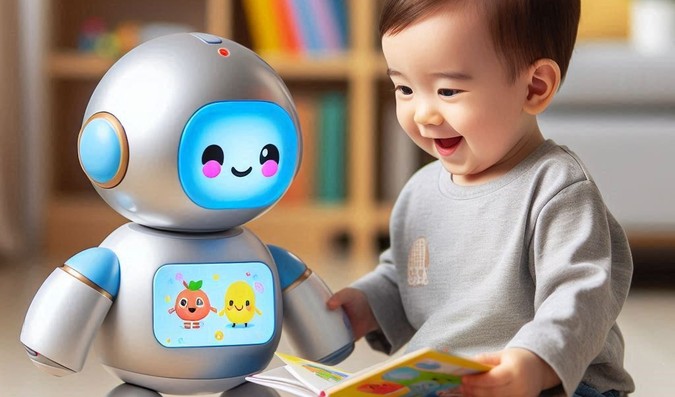
Cover image: The way human babies learn might be similar to how AI systems get trained. Image generated by Dall-E 3.
Stats
- Recommendations n/a n/a positive of 0 vote(s)
- Views 1578
- Comments 0