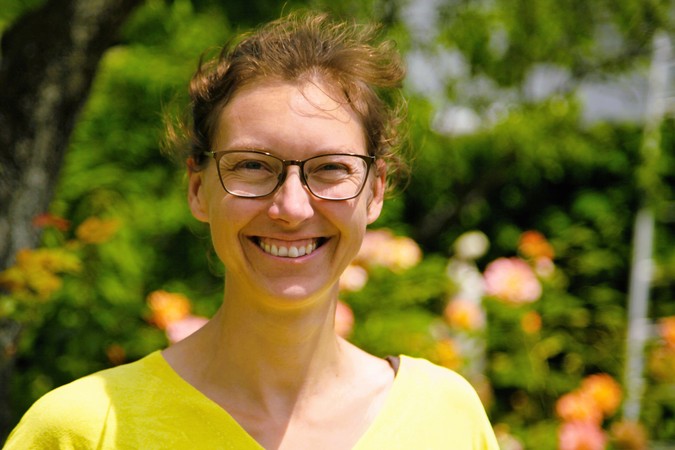
Dr. Kerstin Falk is working as a physicist at the Fraunhofer Institute for Mechanics of Materials in Freiburg, Germany. The Fraunhofer-Gesellschaft is a world leading applied research organization based in Germany with over 30000 employees working at 76 research institutes. She completed her studies in Erlangen, Germany, and then moved for her PhD studies to Lyon in France, where she conducted research in nanofluidics using molecular dynamics simulations. This topic was not part of her curriculum during her studies, so it was a new and exciting field to explore! After some years as a Post Doc at the University in Lyon as well as at MIT in Cambridge, US, Kerstin stumbled across a job offer at the Fraunhofer Institute, which seemed to be tailored exactly to her knowledge and skills. Now, eight years later, she is still working there. We have been asking into why Kerstin decided to pursue a career outside of academia and what she finds rewarding about it.
What is your research about?
I am conducting fundamental research where I am modeling friction and wear in lubricated systems, with a strong focus on systems which are relevant for everyday-applications. For example, it is relevant in systems such as lubricated bicycle chains, car engines, and the automotive industry in general. Currently, I'm also involved in projects related to wind turbines, particularly focused on predicting wear and addressing the challenge of determining when these systems will fail.
Can you give us a glimpse into a typical workday for you?
A significant portion of my day involves project work. As part of a group that specializes in numerical simulations of different systems, my daily routine revolves around computer simulations. I design and set up these models, simulate them, analyze the data, and interpret the results both from a physical and mathematical standpoint. Collaboration and discussions with colleagues are also essential for generating new ideas and interpreting results. Additionally, I often present these findings to our industrial clients, which requires adapting the communication to their specific needs.
Some time ago, my role was elevated to team leader, supervising and coordinating the work of about four people, Master or PhD students and postdocs. Since I became a mother about a year ago, I am only working few hours where I focus on this part, especially the supervision of the doctoral students, leaving the actual project work to the other people in the team. It is exciting to be involved in research as well as other areas and take on various tasks.
How does your current work differ from your experience in academia?
The main difference lies in the breadth of projects and topics I work on. During my PhD and postdoc, I focused on a specific research question and had the opportunity to delve deep into a particular system. However, in my current role, I work on multiple projects simultaneously, which means I can't delve as deeply into each one. It requires organizing my time efficiently and selecting the most interesting aspects to explore further while balancing the rest. Another significant difference lies in the interaction with our industrial clients. Since many of our research inquiries are commissioned by companies with specific needs, we often find ourselves translating complex and abstract research findings into easy-to-understand language that can be readily applied in practical situations.
What led you to choose a career outside of academia?
It wasn't a deliberate decision to leave academia, rather, I pursued “the path of least resistance” one could say (laughs). Working at Fraunhofer is not necessarily an exit from an academic career; it offers a stimulating environment right at the interface of academia and industry. Although I believe I could still pursue an academic path if I chose to and worked hard enough, I find my current position enjoyable and appreciate the stability it provides. Additionally, I have the freedom to conduct scientific research, albeit with more diverse and practical applications.
Do you see any advantages in your current job compared to academia?
One significant advantage is the stability that comes with a permanent position. Unlike the pressure to publish frequently in academia, I am not bound by strict publication requirements for the sake of my job. The working environment at Fraunhofer also allows me to strike a balance between scientific work and other responsibilities, such as collaborating with industrial clients, writing proposals, and handling administrative tasks. Overall, I find the combination of scientific research, applied projects, and a stable position to be quite advantageous. On top of that, the Fraunhofer Institute prioritizes a family-friendly work environment, ensuring that work-life balance is not only a concept on paper. This aspect is particularly important for me, as I am currently juggling work responsibilities with the care of a young child.
Thank you Kerstin, for taking the time to answer our questions and being so patient and clear in your communication, while at the same time well handling the entertainment of a toddler😉
In case of any questions or for further information about available positions, you are welcome to contact Dr. Kerstin Falk via LinkedIn!
Stats
- Recommendations n/a n/a positive of 0 vote(s)
- Views 1825
- Comments 0